
“We can be revolutionary in what it means to be an older adult.”
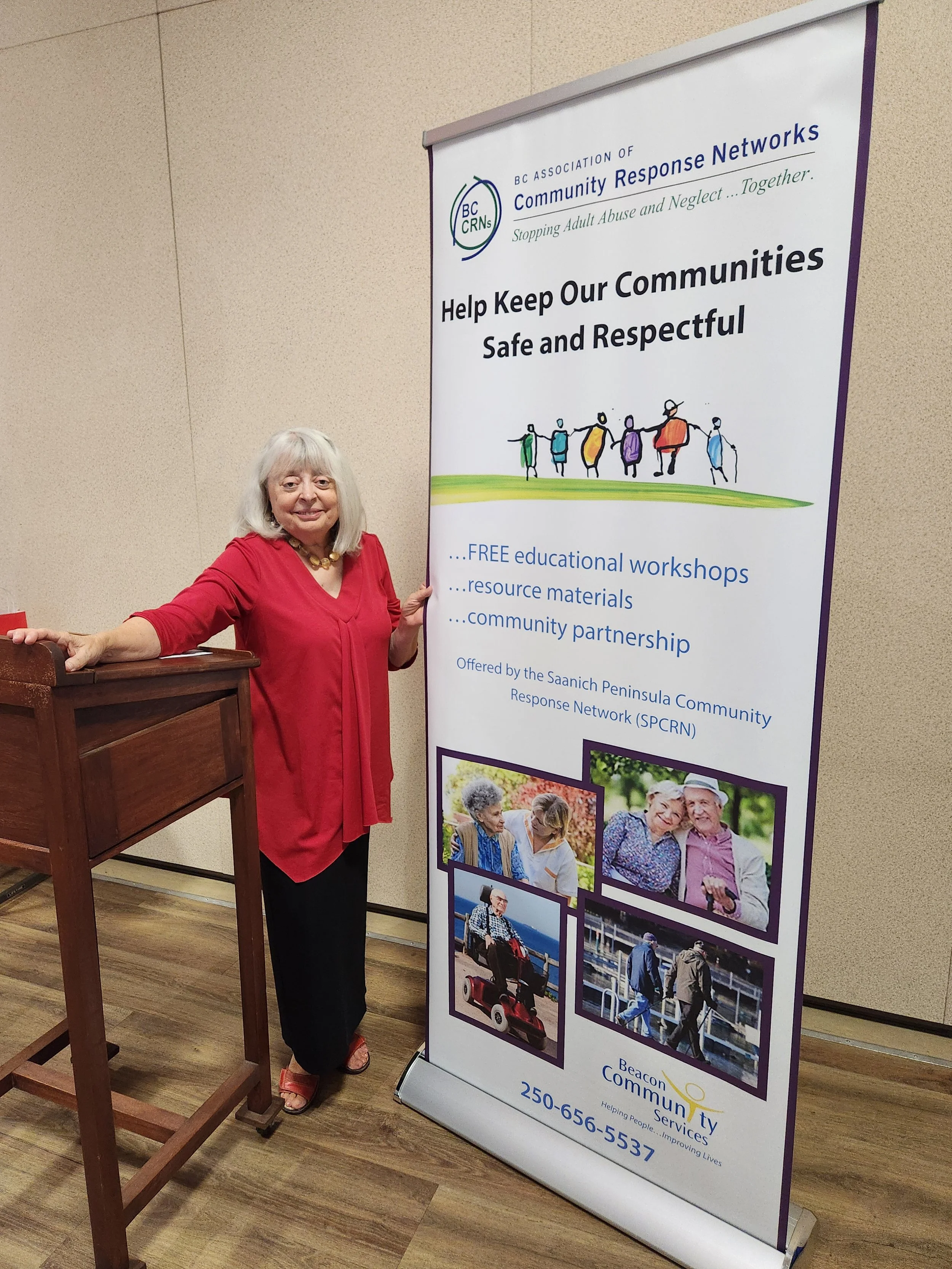
Anna Hudson is a mental health wellness facilitator and coordinator for the Saanich Peninsula Community Response Network (SPCRN)
Written by Jordan Fish
Anna, 74, has the presence of your favourite high school teacher - she’s approachable, kind and certain to have the answer you’re looking for. We sit in a cozy lounge in the SHOAL Community Centre as she begins to share her story.
“I’m originally from Thunder Bay, Ontario. I started out as a journalist, lived in Ottawa for many years and came out to Victoria to go to the University of Victoria where I got my Bachelors degree in Social Work. My first job was with Beacon Community Services in Sidney – it was a much smaller organization then and I worked in their employment services before working in private companies as a Life Skills instructor.”
After several years, I decided to obtain a Master of Arts degree in California. Later, I moved to Vancouver for seven years, and during that time, a lot of things happened to me that culminated into a massive mental health breakdown. That took me back here to Sidney, where I began to slowly heal and find a new life path.”
Gradually Anna rebuilt her life through therapy, support groups, and volunteering with Beacon Community Services, transitioning to a full-time employee as a rental and activity coordinator at the SHOAL Centre. In that time, she also met her husband, Russ, who worked at SHOAL as the chef.
Though she has retired from her role as rental and activity coordinator, Anna continues to share the tools and insights she gained through her own healing and experience. She now facilitates mental health wellness programs for older adults and has also spent the last decade as the Coordinator for the Saanich Peninsula Community Response Network (SPCRN), under the BC Association for Community Response Network, which offers free public education about stopping and preventing elder abuse, neglect and self neglect.
“I tell the mental health wellness groups I run that yes, I am there as a professional facilitator, but I am also there as a participant.”
The experience of stigma, embarrassment and judgement in our culture about depression and anxiety, are common themes in her sessions. She believes deeply in creating spaces where people can share openly and witness each other without shame. To Anna, mental illness is no different than any other condition, removing shame allows people to examine it honestly and openly.
When asked whether technology comes up in her work, the answer is instant: “We talk a lot about technology.”
She describes how the challenges cascade for older adults: “Trying to keep everything working is so hard. It’s tough to figure out if something goes wrong - it is so hard to find an actual person to talk to. And now, you’re dealing with AI such as a website chat or a robo voice, or when finally being able to call someone, being put on hold for long periods of time, then struggling to understanding the voice on the other end of the phone when you finally get through!”
Anna got her first cell phone in 2016 to stay connected with her grandchildren and to use for travelling. “And then I realized how valuable it was for everything I could do on my phone!”
But with those benefits comes the constant churn of updates and new devices. “I now have four remotes just for the TV,” she says with an exasperated laugh.
“We [baby boomers] grew up with commercials that promised you a lifetime warranty. Things used to be made to last! Now there’s always a new form of technology – be it hardware or software.”
Her message is clear: adaptability, and outside support, are key to keeping up with digital innovation. One such resource is readily available at Beacon Community Services at the SHOAL Centre, where volunteers can assist older adults with their devices for 1-on-1 help. The consequences of not having access to this support are significant. From banking to healthcare, digital systems can feel daunting and inaccessible.
“I remember when home visits used to be expected to get something fixed,” she says.
Now it’s about creating another password just to set up a profile so you can get alerts, while also needing an email account in case you have to reset the password you inevitably wrote on a sticky note that’s now gone missing. It’s no wonder older adults feel anxious or reluctant to participate online.
Anna stresses that her experiences do not speak for every older adult. “There are junior older adults (55 - 75 years old), middle older adults (75 - 85 years old) and senior older adults (85+ years old).” They all have their own experiences and needs, and training must match where each person is in their digital learning journey.
“In my experience, we all learn best by demonstration and practice,” she says, gesturing to the TV behind me. She suggests a need for workshops where participants can learn video calling together, first watching it demonstrated on a large screen, then practicing with someone for that curated support. This hands-on approach could build familiarity and confidence, which is essential, especially when updates continually change how devices look or work.
She emphasizes that the language we use matters. It shapes how older adults view themselves and how we view ageing as a whole.
“There’s a real shift from using the term ‘seniors’ to the terminology of ‘older adults’. Just the sound of that is already so empowering.”
Throughout this conversation, I occasionally catch myself using “seniors” - a reminder that this shift is also a skill that takes practice.
“There’s a lot of difference between saying: “‘there’s an older woman waiting for you in the lobby’ compared to ‘there’s this little old lady waiting for you in the lobby.’”
The imagery is striking: one phrase conveys capability; the other is of someone fragile and oddly shrivelled. These subtle choices influence how we, as a society, perceive aging.
“We, the baby boomers, which are the bulk of the population, are instrumental in changing how people experience aging.”
For those interested in exploring these topics further, Anna recommends the BC Association of Community Response Networks’s program titled ‘Spotlight on Ageism’.
“We can be revolutionary in what it means to be an older adult. People want to be our best and be our own advocates.”
If digital equity can be a cog in that transformation, then growing older might just become the most exciting stage of all - no matter how many remotes you end up having to use.
